System E: Why we are not “Wrong”, Just Out-of-Bounds

The Trans Pride flag is used here as a general representative for all non-cis identities.
Emil Pasqualini | January 2026
A very personal article, probably wrong in many ways and surely not 'general', representing the struggle of finding the correct expressions for the complex behaviours, feelings, and needs of human beings. Motivated by personal struggle.
Abstract
We spend half our lives trying to explain the inexplicable with words. We use metaphors, colours, flags, and endless, exhausting discourse to describe the sensation of being. But words are messy. They are noisy, lossy, and prone to misinterpretation by the receiver.
I am an engineering student and deal in signals, noise, and systems. And lately, confronted with the chaotic data of my own existence, I asked myself: What happens if we subtract the emotion? What remains if we treat gender dysphoria, societal perception, and the self not as a "feeling", but as a dynamic system?
The result is System E. It is a mathematical derivation of why the problems of living (queer) authenticity in a normative society are a signal-to-noise problem and why the transmission error lies not with you, but with the receiver.
1. Defining the Internal State Space
Let us define the individual not as a static entity, but as a closed system $E$. This system contains the ground truth — the internal states that constitute identity, regardless of whether they are observable to the outside world.
We define $E$ as a tuple of time-variant variables and constants
where
- $G(t_G)$ (Gender Identity) is the true internal signal. It is a function of time $t_G$; it is fluid, not fixed (if static, $t_G=0$).
- $A(t_A)$ (Appearance/Expression) is the intended output signal (style, clothing, demeanour). This is also time-variant.
- $S$ (Biological Sex) represents the hardware (chromosomes, anatomy). For this model, we view $S$ as constant, though we acknowledge it is mutable hardware.
The most radical — and necessary — axiomatic shift lies in the definition of the domain of $G$. Society generally operates on a scalar logic (integers), expecting discrete values of $-1$ or $1$. However, human consciousness operates in higher dimensionality.
We define $G$ not merely as a scalar, but as a complex state vector (or phasor) in the complex plane $\mathbb{C}$. We confine the valid state space to the Unit Disk ($\mathbb{D}$)
$$ \mathbb{D} := { z \in \mathbb{C} \mid |z| \le 1 } \tag{2}, $$ where $G$ exists, $$ G(t) \in \mathbb{D} \tag{3}. $$
In this topological map:
- The Real Axis represents the normative spectrum: $-1$ corresponds to Masculine/Man ($M$), $+1$ to Feminine/Woman ($W$).
- The Imaginary Axis represents the orthogonal gender dimension: $i$ denotes Pangender (full saturation), while $-i$ denotes Agender (anti-saturation).
- $0$ (The Origin) represents 'Non-Binary' in its truest sense: the neutral center, equidistant to all poles.
Any point $z = a + bi$ within this disk represents a valid identity coordinate.
Consequently, biological sex $S \in \mathbb{R}$ is expressed as a value on the real continuum to ensure the inclusion of intersex variations:
$$ S \in [-1, 1] \tag{4}. $$
Appearance ($A$) challenges mathematical rigidity, as it could theoretically be represented by an infinite-dimensional vector. As a necessary simplification, we define an appearance mean value $A \in \mathbb{D}$, which maps the visual presentation onto the same complex plane as $G$. It is computed as the arithmetic mean of $N$ individual appearance features $\alpha_n$ (where each feature $\alpha_n \in \mathbb{D}$), such as
$$ A = \frac{1}{N} \sum_{n=0}^{N-1} \alpha_n \tag{5}. $$
2. Independence and Causality
A fundamental error in societal processing is the assumption of correlation. This approach corrects this.
For Appearance $A$, we assert stochastic independence
which is the mathematical way of saying that a skirt does not equal a woman, and a suit does not equal a man. These variables are orthogonal. This assumption does not neglect the statistical reality that skirts are predominantly worn by women and suits by men; however, in this model, $A$ represents the internal, intended appearance—stripped of any societal layer. Any perceived correlation is cultural noise, not system architecture.
Regarding biological sex $S$, we declare
$$ \rho(S, G) \neq 0 \quad \text{but} \quad S \nRightarrow G \tag{7}, $$
and accept a statistical correlation ($\rho \neq 0$), largely due to socialisation, but there is no causality ($\nRightarrow$). The hardware does not write the software.
3. The Output Vector: The Tragedy of Transmission
The pain of existence does not occur within System $E$ — internally, the system is consistent. The pain occurs at the interface. We introduce the external parameter $p_s$:
- $p_s$ (Societal Perception Parameter): A noise filter that exists outside of $E$, i.e. $p_s \notin E$. It represents the binary, normative lookup tables of the observer (worst-case, as $p_{s,i}$ is individual and may exist within certain $E_i$).
The Perception Vector $\vec{P}_E$ describes the signal the world actually receives. It is a distorted, quantised projection of the truth, formalised as
Here, we identify three problems of the societal algorithm:
- The Latency ($t - t_1$): In line 1, we see that the perceived gender $g$ depends on $G(t - t_1)$. $t_1$ is the "latency of realisation"—the time it takes to process, articulate, and transmit an internal shift, if there is any. The world is always interacting with a ghost of who one was yesterday.
- The Distortion Filter ($p_s$): In line 2, expression $A$ is convolved with $p_s$. I transmit "Avant-garde high fashion, neglecting all stereotypes"; the observer receives "Man in a dress". The error is in the demodulation.
- The Detection Error: When e.g. $G = i$ (Pangender), but the observer's parser $p_s$ can only handle binary, real-valued integers, the system fails. Society forcibly replaces this error with nearest recognised integer (usually based on the assumed $S$).
3.1 The Patch: Variable $\gamma$
We introduce a control variable for the perceived biological reality $s_{\text{ext}}$
$$ \gamma \in [0, 1]\tag{9}, $$
which represents any form of gender-affirming care and is not a correction of the internal state, but acts as a transformation operator for the external projection and/or internal functionality. It is the modification of the output signal to reduce the noise caused by the flawed detector of the observer ($p_s$). We hack the body so the world’s software doesn't crash when it looks at us.
However, $\gamma$ can act as a corrective mechanism if the System $E$ detects an incompatibility between its own Sex $S$ and Gender $G$, represented by the internal dissonance variable $$\delta_{SG} \in [0, 1]\tag{10},$$or dysphoria, which a high-valued $\gamma$ can compensate (Transition).
Crucially, this implies that the spectrum of Trans* identities is far broader (and more widespread across people) than just those experiencing harm caused by $\delta_{SG}$. The logic proves that identity is valid with or without dysphoria, even if society often only recognises those where the struggle is visible.
4. Tuning the Filter: The Variables of Bias
We must ask: If the societal perception parameter $p_s$ causes so much distortion, why is it configured this way? The filter is not a constant of nature; it is a learned algorithm. It is a neural network trained on a specific, limited dataset.
We can define the configuration of the filter $p_s$ as a weighted sum of specific cultural biases
$$ p_s = \sum_{i=1}^{N} w_i \cdot B_i \tag{11}, $$
where $B_i$ represents a specific bias (input) and $w_i$ represents the weight (significance) society assigns to it. The three dominant variables tuning this filter are:
4.1 Overfitting on a Binary Dataset ($B_{data}$)
In machine learning, "overfitting" occurs when a model learns the training data so precisely that it cannot generalise to new data. (Western) Society has been trained for millennia on a dataset where $N=2$ (Man/Woman, Adam/Eve), additionally influenced by heteronormativity and patriarchy. Consequently, the societal algorithm has overfitted. When it encounters a data point outside its training set (e.g., $G \neq S$ or $G$ as a variable instead of a constant), it does not see a new valid category; it sees a prediction error. It rejects the data because its model lacks the dimensions to map it.
4.2 The Ambiguity Cost Function ($B_{fear}$)
The human brain is wired to reduce metabolic cost by categorising quickly. Ambiguity, e.g. caused by $A \neq S$, requires energy. Therefore, the societal algorithm includes a "Cost Function" that penalises undefined states. We can model this resistance for the example of gender ambiguity as
$$ \text{Cost} \propto \frac{1}{\text{Certainty}} \tag{12}. $$
The less certain the observer is about your gender, the higher the cognitive "cost" (discomfort/fear). To minimise this cost, the observer aggressively auto-corrects the signal to the nearest binary option, forcing the perceptions $g_{\text{ext}}$ and $s_{\text{ext}}$ to align with their comfort zone, not your reality.
4.3 Confirmation Bias ($B_{loop}$)
Finally, the filter is recursive (a semi-self-supervised reinforcement loop). It feeds its own output back into the input. Every time media or culture portrays a stereotype, the weight $w$ of that stereotype increases. This is a positive feedback loop that solidifies the noise until it is mistaken for the signal itself. Furthermore, $B_{fear}$ prevents new data from being used as training data to break that loop.
5. Conclusion
The analysis of Equation $(8)$ yields a conclusion that is as logical as it is liberating.
If $\vec{P}_E$ (how you are seen) does not match $E$ (who you are), it is not a system failure of the individual. Your system is valid. The issue is a signal-to-noise ratio failure: we are broadcasting a complex, multi-dimensional, analog wave $E$, but society operates mostly on a low-bandwidth binary channel. Consequently, the signal is compressed, distorted, and ultimately lost in the noise of binary expectation.
In the worst case, these distortions manifest directly as a loss of quality of life: systemic struggles caused by societal expectations, juridical boundaries, physical violence, et cetera.
And if I may add one final thought: it is not only queer people who suffer. The observer, living with a highly distorted worldview, pays a price too. No one can convince me that a life fuelled by hate and frustration towards fellow human beings is a happy one.
We are not "wrong"; our system simply has a higher dimensionality than the receiving system, which causes "out-of-bounds" errors that society—and those affected—have to deal with.
Disclaimers
I am neither trained in psychology, sociology, nor gender studies; this article is intended simply as a thought experiment for explaining my very own system $E_{\text{Emil}}$ and how it would generalise. If you encounter any errors or wish to discuss the model, please feel free to email me via e.pasqualini@outlook.at.
This piece is a collection of personal insights rather than academic research, hence the absence of citations and claims to novelty.
Please cite me :)
@misc{pasqualini2026systeme,
  author       = {Pasqualini, Emil},
  title        = {{System E: Why We Are Not "Wrong", Just Out-of-Bounds}},
  year         = {2026},
  month        = {January},
  day          = {04},
  howpublished = {Personal Blog via emilpasqualini.eu},
  url          = {https://emilpasqualini.eu/essays/system-e},
  note         = {Accessed: },
  language     = {English}
}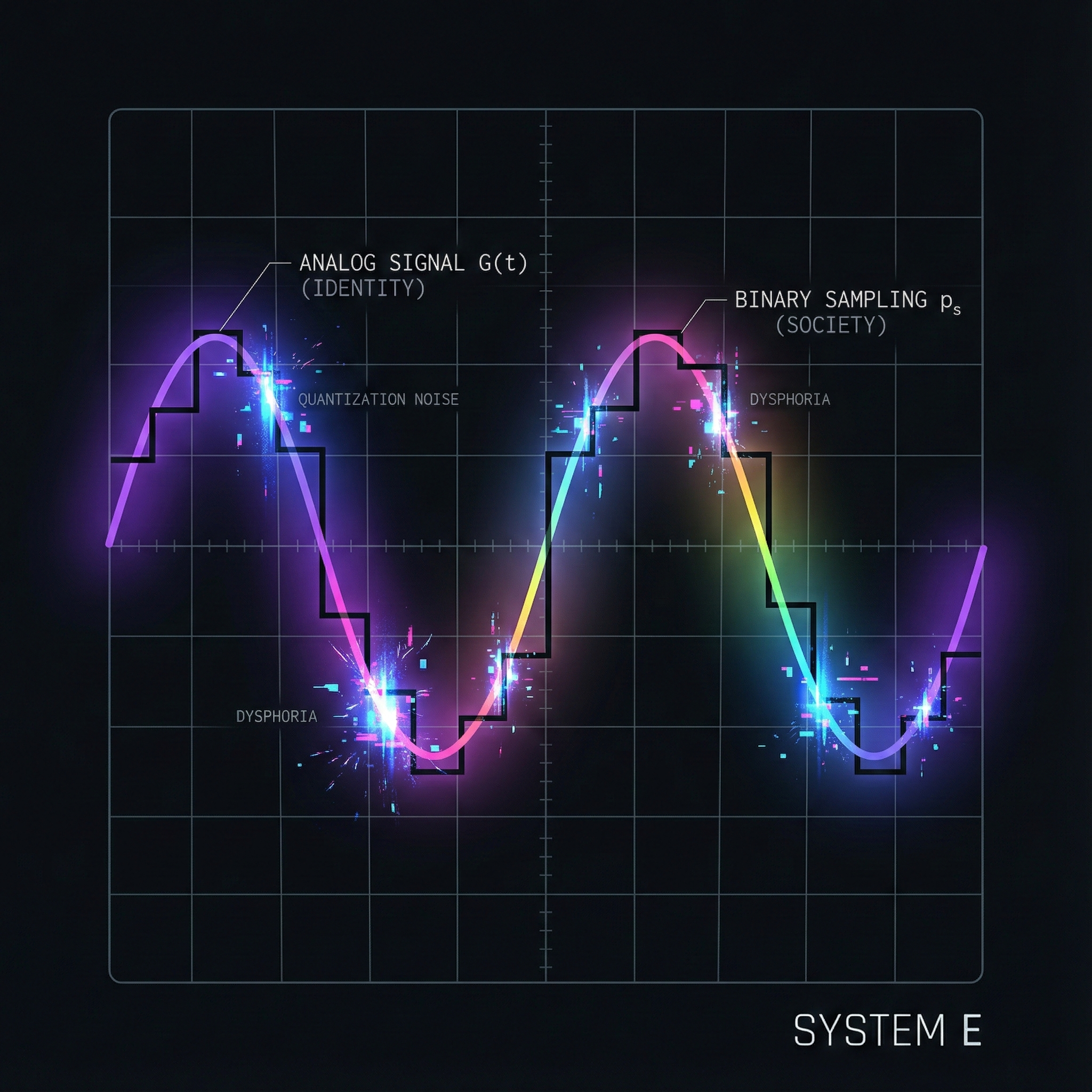
Just a catchy image to get readers, not important ;) It visualises the analog System E and the quantisation error caused by p_s. (Generated using Gemini v3 Pro)